I bought a camera to take with me to Poland, and I’m feeling a little conflicted about it.
I’ve long been interested in photography as a philosophical concept. During my thesis research I was struggling with the images of the dead, particularly those that compressed the human into a pile of indistinguishable bodies. There is something so profane about the publication of these pictures. I recognize their historical significance and the value they hold in the project of justice, historiography and remembering. It is important that they cannot be viewed with quiescence. The discomfort is the point.
I needed a break and an excuse not to look so I read widely on the subject of photography instead, and the content of Susan Sontag’s Regarding the Pain of Others has lived on the edges of my thought ever since, springing up occasionally to remind me of its impact. I read it again as I reckoned with what it would mean to be a tourist with a camera in the places I will visit. An iPhone photo can be surreptitious, an image quickly and (perhaps) guiltily taken. The act of using a camera requires composition. Thought must be given to the images taken with an older camera because they aren’t as out-of-the-box user friendly as a cell phone camera. The camera is only a camera and nothing else. It is a means by which to see the world in a very specific way.
This is Lee Miller, a woman I admire greatly. From The New Yorker:
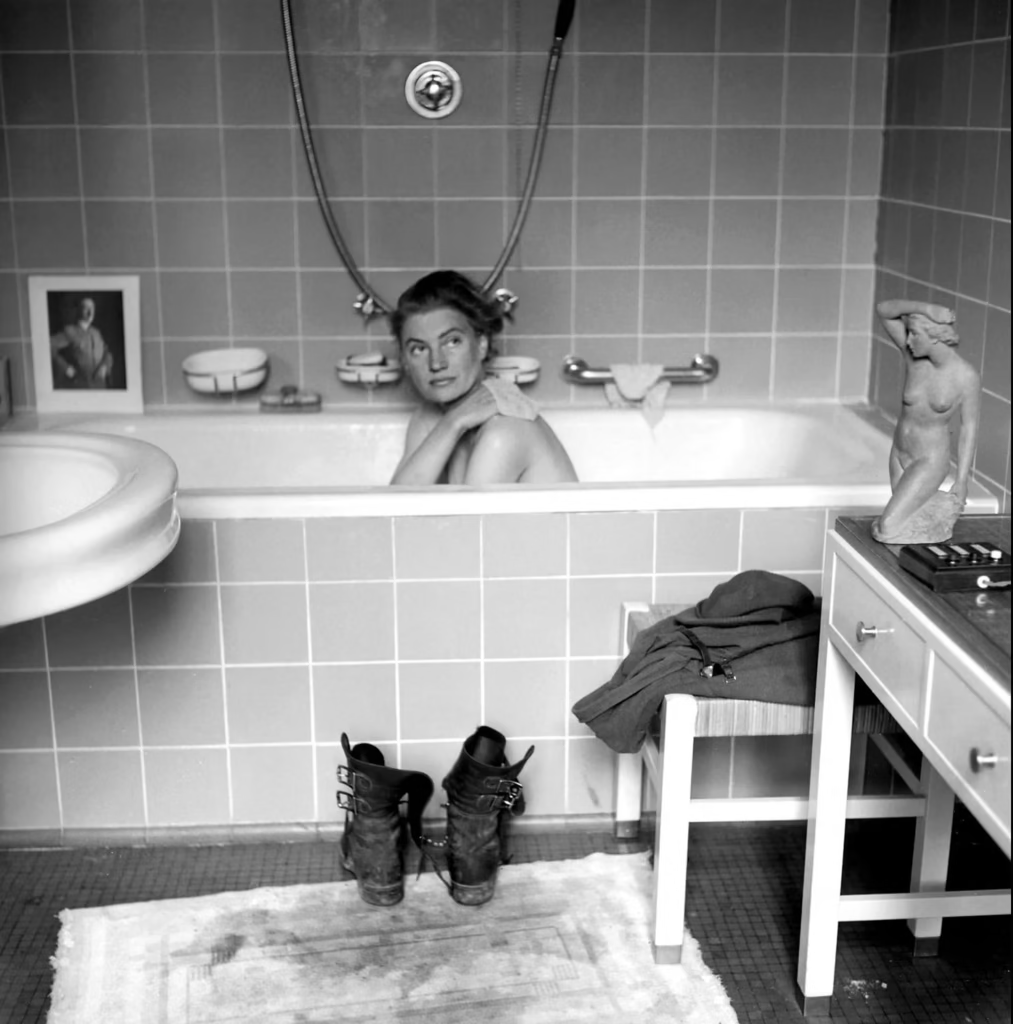
On April 30, 1945, the photojournalist Lee Miller took a bath in Hitler’s tub. A correspondent for British Vogue, Miller had posted up in the Führer’s abandoned apartment in Munich along with a group of G.I.s from the 179th Regiment. That morning, she had been among the first to enter the newly liberated Dachau. At Hitler’s residence, before climbing into the tub, she set up her camera; her lover at the time, the Life photographer David Scherman, took a shot as she bathed. In time, the picture would become famous as a kind of apt visual metaphor for the end of the war. The same day, across Germany in a Berlin bunker, Hitler and his new wife, Eva Braun, took their own lives. In a letter to her Vogue editor, Miller described Dachau’s “great dusty spaces that had been trampled by so many thousands of condemned feet—feet which ached and shuffled and stamped away the cold and shifted to relieve the pain and finally became useless except to walk them to the death chamber.” In Scherman’s photograph, some of that same dust has tracked from Miller’s boots onto Hitler’s white bathmat.
Susan Sontag characterized photographs as objectifications that ”turn an event or a person into something that can be possessed. And photographs are a species of alchemy, for all that they are prized as a transparent account of reality.” Roland Barthes wrote: “Ultimately, Photography is subversive not when it frightens. repels, or even stigmatizes, but when it is pensive, when it thinks.” This photo thinks. The camera has served, here, as a tool to think through the madness of the war, of a day spent in Dachau, of needing a bath, and wanting to spit on Hitler’s legacy. This is composition as lyric, history told in a visual poem.
I will be bringing my camera with me along with the two Sontag quotes I end with here at the forefront of my mind. I hope to use the pictures I take as a means by which to think about what I will see.
I hope the act of using a camera gives movement to the intention of remembrance and mourning, of reflection and sorrow, and of being present, bodily, in the places I go.
“All memory is individual, unreproducible—it dies with each person. What is called collective memory is not a remembering but a stipulating: that this is important, and this is the story about how it happened, with the pictures that lock the story in our minds.
“To designate a hell is not, of course, to tell us anything about how to extract people from that hell, how to moderate hell’s flames. Still, it seems a good in itself to acknowledge, to have enlarged, one’s sense of how much suffering caused by human wickedness there is in the world we share with others. Someone who is perennially surprised that depravity exists, who continues to feel disillusioned (even incredulous) when confronted with evidence of what humans are capable of inflicting in the way of gruesome, hands-on cruelties upon other humans, has not reached moral or psychological adulthood. No one after a certain age has the right to this kind of innocence, of superficiality, to this degree of ignorance, or amnesia.”
Citations, anyone? I love a good cite.
This substack has an excellent overview of Lee’s critical contribution and her amazing work.
Barthes, Roland. Camera Lucida: Reflections on Photography (1st American ed.). New York: Hill and Wang, 1981.
Sontag, Susan. 2003. Regarding the Pain of Others. Farrar, Straus and Giroux, 2003.
Witty, Patrick. “The Photographers in Hitler’s Bathtub.” Field of View (Substack), September 18, 2023.
Wiley, Chris. “When Lee Miller Took a Bath in Hitler’s Tub.” The New Yorker, January 9, 2024.