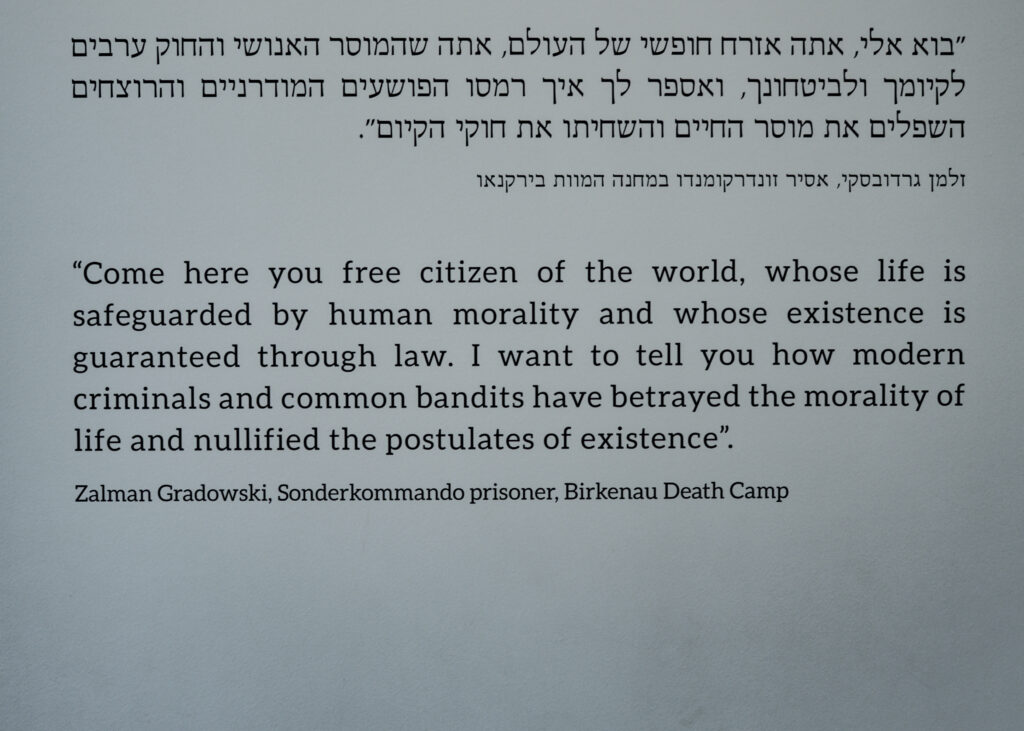
In preparation for this trip, I spent a lot of time reading about land. I’m interested in the construction of land after catastrophe: the doubling that exists for Poland, specifically, to preserve a history erased (literally and/or figuratively) with the tension of memorializing that history. I find myself fascinated by the fragile project of keeping space for a history where the populace has to reconcile the impossible question of how to have an "after" following atrocity on an unimaginable scale.
Andre Corboz’s article “The Land as Palimpset” (published in the journal Diogenes in 1983) includes a section on the meaning of maps that resonated deeply for me, and I think in its whole can be also be read as a definition for the practice of history and remembrance (bolding mine):
Brett Kaplan was also influential to me in this respect. Here's a snippet:
I was worried about visiting Auschwitz-Birkenau. I know what I was intending - to bear witness, to *see* - and I had an inkling I wouldn't have much time to do that. In part, that was true.
There isn't a slow time to visit. The museum and memorial runs tours every 15 minutes in multiple languages, and you move at a clipped pace for the full duration. There is no down time to reflect. We took the 6 hour tour and still felt rushed. Our tour guide was excellent, though well rehearsed probably underlines the problem I had somewhat. I didn't really want to hustle through a walking documentary, but as far as I understand it, you can't visit without a guided tour.
I wasn't sure I absorbed much, honestly, until I came home and had some down time. I have a pretty deep understanding of the history, and I found myself frequently lagging behind to try to carve out a moment of reflection when the guide was covering something I knew well. This isn't a place for that; maybe it shouldn't be.
So what of Auschwitz-Birkenau as place? How does it manifest as witness for me?
When I got home, I realized I saw Auschwitz-Birkenau through its trees, and you'll see that reflected in the gallery below. I found this write up later, and this excerpted poem:
 Many, like I, confessed to the trees here, beseeched remembrance
Wanted to climb to the top and fly away
All traces of them vanished, they were swept away
And the trees saw it all, the trees heard
And, as is their custom,
Grew, sprouted leaves, remained silent
- Halina Birenbaum
I don't know which of the trees I saw may have stood during the period of operation, but they stand now, and watch as people carve time out to visit this place of mourning. The trees are keeping the integrity of this place, I think.
Click the first image to open a gallery with descriptions.
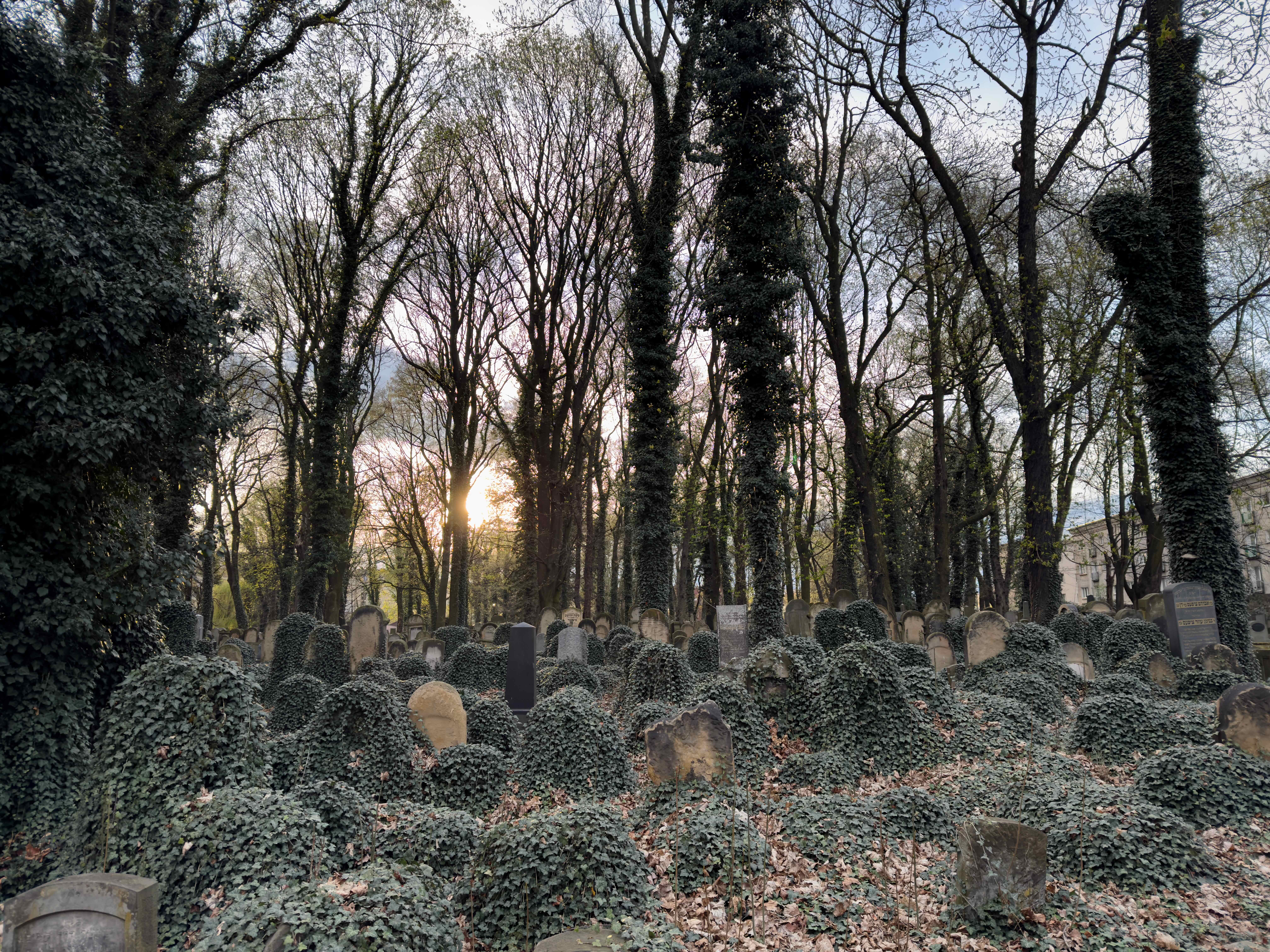
When I got back to our rooms, I ventured out to get some food. I stumbled into the New Jewish Cemetery, and finally had a breathing moment to reflect on what I had seen. The graveyard was riotous with plant life, and the sky seemed to be speaking prayers with the sunset. I paused to think about the dead who do not rest in such beautiful places and have no private matzevot to mark their bones at rest.
This post was a bit esoteric, and though I do think it may help someone, someday, wrestle with the complexity of visiting these sites, and I wanted to capture my own thinking, I risk effacing the true horror of this place and the people who were killed here. I'll end my post here with some poetry contemporaneous to the period of the Warsaw Ghetto written by Itzhak Katzenelson.
Itzhak’s story is emblematic of the Jewish experience in Poland. He was in the Warsaw ghetto right through to the uprising. During this time, he wrote prolifically. His plays were performed at the Janus Korczak orphanage for the children who were later escorted by Korczak to Treblinka (I’ll have more to share of Janus’s story later). His wife, Hanna, and his two younger sons, Yomel and Benzion, were deported to the Treblinka death camp shortly after the mass clearing of the ghetto began, on August 14, 1942, where they were murdered. Itzhak was hidden in the Aryan section shortly after the Warsaw uprising began with his remaining son Zvi and was later deported to Birkenau, by way of the Vittel Camp and Drancy transit camp, where he and Zvi were murdered on May 1, 1944. That we have his writing today is a fierce testimony to the will of survivors who retrieved it from hiding.
Woe to You
Itzhak Katzenelson
Woe to you, who have murdered all my children
and all my old ones, the oldest of my people.
I tell you, nation of murderers, children are never lost,
the aged never die before their time.
Woe to you, who have entirely exterminated my peaceful people,
burned down my houses of worship,
all my shuls together with the Jews in them,
and my holy Jewish cities.
Woe to you, who have destroyed an unarmed people,
who have destroyed a people unprotected by anyone.
I tell you, those who were unprotected will punish you:
you will be judged by the people without weapons!
Woe to you, nation of child-killers, murderers of the old,
who have annihilated my children and my old ones.
I tell you, murdered old people cannot be hidden,
murdered children heave from the grave as from their mother’s womb.
I tell you, innocent murdered Jews do not die,
a people is not destroyed without reason.
I tell you, nation of murderers, Jerusalem cannot be laid waste,
Shoot! Shoot into my heart… that is your last shot!
Woe to you, your evil hour – listen – has struck,
soon, soon, a plague on you and you’re finished:
We’ll pursue you on every road,
we’ll burst out of our graves.
With wife and child, with grandpa and grandma,
those shot by you for no reason,
the people you buried alive,
we shall stand up and bleakly stare at you.
We shall stand up on every single road,
silent, silent, silent as the grass;
mutely we’ll stand and mutely we’ll ask,
why have you murdered us, why?
Bloody, unclean, you’ll run away
and a savage terror will seize you:
we, the dead, will head you off on every road,
we’ll block you on every path.
We, the slain, will stand up and stare at you,
stare at you mutely in our anguish,
and, staring at you, devour you in silence:
we’ll cling to your very bones.
In your disgusting body, in your red neck,
as in a filthy swamp, in mud and clay,
you have killed us, the living, and dragged us, dead,
dragged us on your shoulders to your home…
To your home! Your home no longer exists!
It lies in ruins, torn apart, and demolished;
hide yourselves in crevices, in caves and secret places,
you, the lowest murderers on God’s earth!
Hide yourselves! No… only those with shame hide themselves,
you, child-killers, you are without shame!
Crawl, shameless ones, like aliens over your familiar ruins,
and may the crumbling rocks be alien to you.
Search, murderer, for your home and may you never find it…
Wander, as we do, over the earth, and search –
and searching through the ruins, may you lose your mind
and in your madness be cursed!
Run! Run like mice after the war is lost,
not knowing where to run! You murderers, may the
trees on the roads and the blades of grass curse you,
and every frog on the bank of every river.
Run, every German with a murdered Jew around your neck!
Dying, we cling silently to your throat –
we’ll choke you, choke you, but you’ll not choke to death –
turn your heads, your heads, and look around you…
It is we… we, we! These are our fingernails
that grew sharper after death;
You have slain us along every road
and stained every stone red with us.
Now carry us, carry us in fear and terror –
you can’t find the way? March! Forward! Forward!
We, we! We’ll now lead you home,
we’ll lead you, each of you, into his own house.
We’ll bear witness and observe the scene:
how you greet your wife and child,
how you fall on each other’s necks… we shall see it,
we’ll stand and look with our dim and blinded eyes.
No! No! May you, like us, never live to see this.
May each of you find his way to his ruined house
and not find your wives among the living
and find your children dead on their laps.
Dead. Through open doors and cracked walls
hear the curses… Your skin shudders with cold –
your wives are the ones who cursed you
and your own children before they died.
They raise themselves up, blind, blind and frozen,
they come close to you and shake their heads –
your wives and your children come face to face with you,
and we behind – we won’t let you go.
They face to face, and we, we from behind –
why did you destroy us, tell us, why?
You can’t, stand it, you run with every wind,
you can’t drain the bitter cup.
You run, troops of Cain, a wild horde of murderers –
run, guilty ones, run, without pause or rest.
Wherever you set foot, you have committed a murder,
on every morsel of earth you have spilled blood.
In every city and in each forgotten village
you have plunged your hands in Jewish blood;
each of our homes is a dark page
in your book of blood, cowards that you are!
You have chosen the weakest of all,
plundering the forlorn – the easiest prey!
You have fallen on a helpless people
and trampled them, reducing them to dust.
You have been marvelously brave against children
and against the aged… oh, you know, you know the art
of murdering the innocent, the most innocent, you dirty sinner
you, in your cowardice, have made your selection…
You have maimed other nations, but you have exterminated us
tortured us, eaten us like bread,
you drank our old blood like wine, both old and cheap,
oh, who on earth, like us, has been killed without remorse?
You have sated your lust with us as with corpses,
nation of hyenas, you have drunk our blood –
who helped you – was it God? or was it the devil?
If God – may it smell good to him!
But if it’s the devil… may all of you, may you all be cursed,
cursed by God and man, you wild beast!
May you sink deep into the fractured earth with Mephistopheles,
and there, deep in the earth, may you never know peace…
May the earth in her great fury and in her hatred
spit you out of her mouth with loathing
and let you lie dead in the streets, like us, like us,
huddled together with your wife and child.
And may your sister the hyena
suck the last drops of venom out of your body
and may sparrows peck out your eyes
and your deep lying wicked murderous heart.
May you feel with your devoured hearts,
may you see with your eyes oozing out,
as lights flicker and twinkle
from what? and from where? and how? and when?
With worm-eaten hearts you’ll feel, rapers of mankind,
with plucked-out eyes, look, guilty ones, and see
how nations rise up in all the lands,
how cities are rebuilt and bloom in freedom.
With dried-out rotten brains,
with plugged-up putrid ears, listen –
how the sky has brightened after you,
how the earth has smiled when you are gone.
Listen, listen, a marvelous song is ringing out
in love and faith over the whole world –
listen, listen to the mighty voice, free and exalted –
he is singing in the choir of nations, the eternal Jew.
Listen, listen and may a wild storm soon grind you to dust,
and blow you into the deserts with your wife and child –
let no memory of you remain!
Nightmare, be erased, be blown away in the wind!
May 31, 1942
Translated by: Ruth Whitman and Menachem Rothstein.
Ed. by Yechiel Szeintuch in Jerusalem Quarterly, Winter 1982,83 Number 26
Sourced from Poetry in Hell
Reading List
Corboz, André. “The Land as Palimpsest.” Diogenes 31, no. 121 (1983): 12–34. Full text here.
Kaplan, Brett Ashley. Landscapes of Holocaust Postmemory. Routledge, 2011.
Charlesworth, Andrew. “The Topography of Genocide.” In The Historiography of the Holocaust, edited by Dan Stone. London: Palgrave Macmillan, 2004.
About Itzhak Katzenelson
Yivo Encyclopedia of Jews in Europe
EHRI Archives - The Itzhak Katzenelson Collection
Culture.PL entry
About "The Song of the Murdered Jewish People": Andrzej Pawelec and Magdalena Sitarz, “Yitskhok Katsenelson’s ‘Dos Lid Fun Oysgehargetn Yidishn Folk’ as an Autobiography of the Poet and His Nation,” Autobiografia 8 (January 1, 2017): 83–98, https://doi.org/10.18276/au.2017.1.8-05. Link here.