Today, we visited the Bełżec memorial.
As I stood in front of the memorial, I wondered how it could be this overwhelming and so small. I managed to take a photo of nearly the entire memorial area with a 25mm lens. You can take in the expanse without moving your eyes much if you stand in the right spot. I got caught in the idea that you should not be able to grasp in one glance a space where this many people were killed, and where their ashes now lay in 33 mass graves.
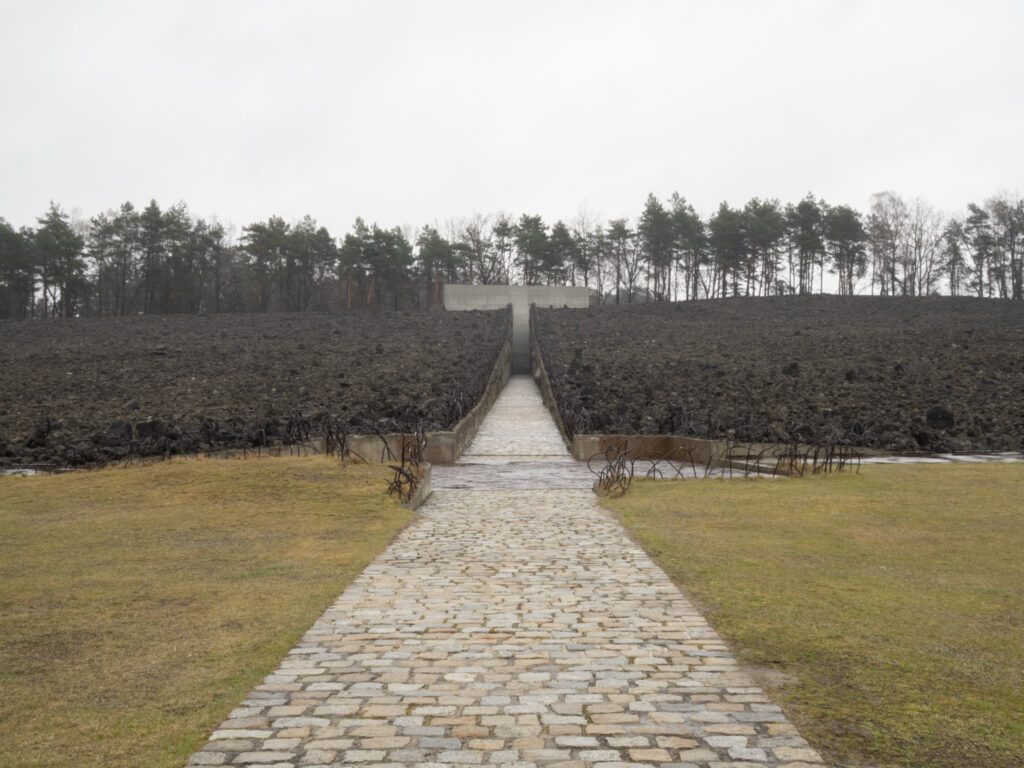
At Auschwitz, I found myself interpreting my experience through the trees. At Majdanek, through weather (more on that later). At Bełżec , I kept coming back to numbers.
11 months of operation (March to December, 1942).
North of 430,000 people murdered, exact figures are uncertain.
Many names of victims are unknown and likely to remain unknown, but the memorial has placed 1,200 common first names for Galician Jews on the memorial wall to stand in representation for the matzevot that cannot be placed for the individual victims.
Only 2 people testified about their experience.
About 100 staff oversaw this killing work, plus or minus a handful at different phases.
How many rocks were placed in the memorial site? The guide wasn’t sure, seemed maybe a bit startled that I asked.
Only a few trees were left standing. The designers of the space wanted to rip out all the trees but left a handful of oaks that were there before the war to serve as living witnesses, our tour guide told us. How many? I forgot to count. I meant to, because it seemed important to me that I know this number of living witnesses, but I got distracted by the number of names of towns people were deported from on the walk up the memorial path.
Even now, as I prepare to publish this post, I’m fretting a bit about whether or not I got a number wrong.
Numbers have a tendency to dominate discourse about the Shoah: how many were killed, where, on what dates, tabulations and deportation lists, tallies of objects. The numbers lose the people. You cannot hold that many human souls in your mind. I know this. I seek out survivor testimony, art, poetry, and fiction to try to find the person in the history. Unpacking the day tonight, I was wondering why I was so caught in numbers, like a resin I couldn’t wipe from my fingers.
As I prepare for bed tonight, I don’t have a complete answer. This is an unfathomable place, and maybe it is as simple as that numbers are something manageable. Any yet, the experience of this memorial was not a cold, numerical experience. I wonder if I was trying to find the people in the numbers today, having stood for the first time on the sight of a purpose built death camp, without a survivor’s writing in my hand to reference. I know it didn’t feel anonymized or trivial to me. Marking each of these things felt vitally necessary.
I have on my to do list to share the details and photos I took of the memorial space, but it’s late and we have a tour arranged for Sobibor tomorrow. And, I need some space to sit down with the photos I took, and reflect. That might not come until much later in the trip or until I am home.
Additional Reading
*Of the more than 430,000 people sent to Bełżec , only 2 escaped, survived, and provided information: Rudolph Reder and Chaim Hirszman. Chaim was killed in 1946 by Polish anti-communist resistance fighters before he could share his story in full, but you can find a transcript of what he did share here. Reder wrote a memoir. I picked it up at the museum on my way out, and you can find it here.
**It’s a myth that the Germans kept meticulous records of the individual Jews they killed. From Yad Vashem:
“Almost none of the Jews murdered in the territories conquered from the Soviet Union were registered; Jews who perished due to starvation or epidemics in all but the largest ghettos were not listed; individual Jews hunted down in fields and forests were not recorded; and most significantly, the millions of Jews who were simply pulled off trains and into gas chambers, in most cases, were not listed by the Nazis.”
Excellent summary of the memorial and it’s meaning from Barbara Buntman can be found here. If you have library access, this article is excellent:
Buntman, Barbara. 2008. “Tourism and Tragedy: The Memorial at Bełżec, Poland.” International Journal of Heritage Studies 14 (5): 422–48. doi:10.1080/13527250802284867.
Arad, Yitzhak. 1987. Bełżec, Sobibor, Treblinka: The Operation Reinhard Death Camps. Indiana University Press.