I found the town of Ostrów Mazowiecka looking for a place to overnight near Treblinka. A review from a historian who had stayed in this odd little hotel we’ve booked into led me to researching the town. Before I unpack the day, I’d like to share a brief overview of the Polish experience of occupation. This is going to be a long post, be forewarned.
Poland’s relationship to the Shoah post-war has been, to say the least, complicated. Initially, in the Soviet Union, Jews were not marked out for a specific, deserved, and defined victimhood. The culture of remembrance we have now took time to root. Today, one could argue Poland has done more than any other formerly occupied country to preserve the traces of the Shoah. Yet, in 2018, Poland passed a law that is regressive in the work of reconciling history. How, then, do we understand a triad of experience that has neatly been packaged into three separate points on a triangle - bystander, victim, perpetrator - that allows for too facile an engagement with history? Beginning with the trauma of Poland’s history in this period is necessary.
Counting death, marking life
I recommend Timothy Snyder’s Bloodlands for a deeper dive, but I will summarize some key illuminating figures from the book here. Between 1933 and 1946 counting deaths by starvation, and understanding the numbers are imprecise, the Nazis were responsible for upwards of 12 million deaths of non-combatants and the Stalinist regime upwards of 9 million in the area Snyder calls the Bloodlands (the territories now constituted as Poland, Belarus, Ukraine, Estonia, Latvia, Lithuania, parts of Romania and in the Western part of Russia). Some 5 million of the killed in this region were Jewish (total estimates of Jewish people murdered during the Shoah vary, but 6 million is a commonly cited figure). The numbers are impossible to hold in your mind.
In Poland, targeting of non-Jewish civilians under Hitler and Stalin’s leadership was also widespread. Estimates again vary widely - 150,000 to 200,000 people were murdered by the Soviets and upwards of 1.9 million by the Nazis. 3,000,000 Polish Jewish citizens were killed. When all was said and done, 1/5th of Poland’s population had been killed including Jewish and non-Jewish victims. Sit with that a moment. 1/5th. The USHMM has an excellent primer on occupied Poland. This is a land marked by murder. From Bloodlands:
Beyond Poland, the extent of Polish suffering is underappreciated. Even Polish historians rarely recall the Soviet Poles who were starved in Soviet Kazakhstan and Soviet Ukraine in the early 1930s, or the Soviet Poles shot in Stalin’s Great Terror in the late 1930s. No one ever notes that Soviet Poles suffered more than any other European national minority in the 1930s. The striking fact that the Soviet NKVD made more arrests in occupied eastern Poland in 1940 than in the rest of the USSR is rarely recalled. About as many Poles were killed in the bombing of Warsaw in 1939 as Germans were killed in the bombing of Dresden in 1945. For Poles, that bombing was just the beginning of one of the bloodiest occupations of the war, in which Germans killed millions of Polish citizens. More Poles were killed during the Warsaw Uprising alone than Japanese died in the atomic bombing of Hiroshima and Nagasaki. A non-Jewish Pole in Warsaw alive in 1933 had about the same chances of living until 1945 as a Jew in Germany alive in 1933. Nearly as many non-Jewish Poles were murdered during the war as European Jews were gassed at Auschwitz. For that matter, more non-Jewish Poles died at Auschwitz than did Jews of any European country, with only two exceptions: Hungary and Poland itself.
Yechiel Weizman's book Unsettled Heritage: Living next to Poland’s Material Jewish Traces after the Holocaust was an invaluable resource to me in my research. Weizman balances the complex task of telling uncomfortable truths with context and nuance. I think it is really important to understand how lawless and terrifying this period was, when contextualizing how Polish people reacted and acted during the Holocaust and in its aftermath, including into today. This passage in particular underscores the lived experience of non-Jewish Polish citizens:
The analytical concept “bystanders,” coined in 1992 by the eminent Holocaust historian Raul Hilberg, has long since been challenged for not capturing the full array of actions, attitudes, and responses of non-Jews who lived in Europe during World War II and witnessed the persecution and extermination of the Jews. In Nazi-occupied Poland, perhaps more than any other country,” this term appears to lose all validity. The German decision to locate its death factories in Polish territory, the general state of terror inflicted on Polish citizens, and the close proximity of the country’s local population to the extensive sites of persecution, degradation, and murder of their Jewish landsmen, meant that simply “standing by” was not a real option. Firsthand knowledge of the genocide in Poland was so direct, writes the historian Dariusz Stola, that it “demanded a reaction, if only a mental one.” This is irrefutably demonstrable in Poland’s middling and smaller towns, whose Jewish souls often made up half or more of the population. In such localities, writes the historian Omer Bartov, the murder of the Jews was all-too-intimate, and was experienced as a “communal genocide.” As opposed to large cities such as Warsaw, Kraków, and Łódź, the Nazi ghettos in provincial towns were usually not hermetically sealed or separated from the outside society by a wall or fence. Not only did Poles in these small towns knew what was happening inside these “open ghettos” and could interact with the Jews on a daily basis, they also watched as their fellow “Jewish townsmen, women, and children were being deported to the extermination camps or shot and beaten to death in wild and brutal “actions” throughout their shared town squares and streets, leaving behind trails of blood... Another undermining of the applicability of the “bystander” category to the Polish case, emerges from new historical revelations on the involvement of large parts of Polish society in the death and dispossession of the Jews.
Armed with this knowledge, one can understand why any suggestion that Polish citizens had been enactors of violence against Jews and complicit in their own occupation is fiercely resisted. In 2018, Poland passed article 55.a as an amendment of the Act on the Institute, commonly referred to as the Holocaust Law (read the President’s statement on its passing here). This article is meant to prevent the defamation of Poles in matters related to the Holocaust (this is a useful explainer). This act has deeply impacted scholarship on the Shoah, illustrated by the experience of a well-respected historian Jan Grabowski from the University of Ottawa who had to fight a defamation case. It is a historical fact that some Polish citizens participated in the Shoah (either by complicit behaviour or killing). It is also a truth that in that lawless land, we should be careful to parse history in its totality.
It is with this context I want to introduce you to this town.
Ostrów Mazowiecka
Ostrów Mazowiecka was occupied by the Germans very early in the invasion and was the site of one of the earliest massacres of Jews. 364 Jewish people were killed on November 11, 1939 in a mass shooting as a reprisal for an arson that spread and set fire to properties in the town (possibly staged by the German police) and blamed on a Jewish man named Berej Tejtel. Berej was hung in the town hall. Survivor testimony recounts he killed himself in despair and was later moved by the Germans to the Town Hall. Other testimony disputes this memory, and shares that he been killed by the Germans. The Jewish citizens were held in his brewery before the massacre. After the mass shooting, a notice was posted publicly, quoted below from Microhistories of the Holocaust:
“By judgment of the military court of Warsaw, all people found guilty of having caused the arson fire in Ostrów, their accomplices, and confidants were executed today. I hereby point out that any act of sabotage will be punished by death.” For the first time, ordinary men had annihilated an entire Jewish community—including men, women, and children—and taken photographs and informed the public afterward.
I wanted to highlight this in the context of the earlier information I shared. The non-Jewish citizenry's response to the Nazi invasion of their town is illustrative. Survivors recount the Poles of Ostrów Mazowiecka helped Germans round up Jews, in exchange for payment and were supportive of the dispossession and murder of Jews. In the first website linked, survivor testimony also records Polish helpers. Further, survivor testimony records that Poles were conscripted by the Germans into filing the mass grave with murdered Jewish neighbours. The same testimony notes that Poles were scared to help the Jews because they feared being killed.
I wonder how I would respond if my city was invaded by soldiers, over 300 neighbours were killed, a notice was publicly posted heralding their murders, and I had been conscripted into filling a mass grave. Add to this the context of long-standing pre-war antisemitism and the sometimes fraught dynamic between Jewish and non-Jewish residents of small Polish towns... It's comfortable to think you would be one of the helpers, but I'm not so certain. Humans are human, after all. Fear and prejudice are a potent mix, and one that doesn't make heroes out of most, otherwise humanity would stop repeating this story.
Before the war, the Jewish population of the town was 7,600 and by 1940, not a single Jew remained, having been killed or fled over the Soviet border, just shy of half the town's residents.
Politics and Victim Identities
Ostrów Mazowiecka can also claim an early involvement in the latest battle over the history of this period. Following the 2018 “Holocaust Law”, Poland funded a number of initiatives that centre Polish resistance and persecution. This town was one of the first to receive a new type of memorial via the Called by Name project (more about that below).
I highly recommend you read Mikhal Dekel’s article “Memory Wars in Poland: When My Family’s History Turned into Political Currency” in the Journal of Genocide Research. Mikhal is the daughter of Hannan Dekel, nee Channania Tejtel, who owned the Tejtel Brewery where the town’s Jewish citizens were held before they were shot, en masse. Mikhal’s article recounts her experience dealing with Magdalena Gawin and an invitation to come back to the town her family was driven out of for a commemoration ceremony for Magdalena’s great-aunt, Jadwiga Długoborska, who Magdalena claimed had been killed for helping Jews. Yad Vashem did not find sufficient proof to add this woman to the Righteous Among the Nations, but that isn't necessarily confirmation it didn't happen. There are a myriad of undocumented or unprovable instances where Polish people helped their neighbours. A year after her visit, Magdalena was appointed Deputy Minister of Culture and the Pilecki Institute that she founded arranged for a memorial to be erected to her great aunt via the Called by Name project, which places memorials to Poles who were killed for helping Jews. It seems to be explicitly in response to Yad Vashem’s criteria for appointment to the Righteous Amoung the Nations. It is worth reading this interview with Magdalena, in contrast to Mikhal’s article to understand the dynamics in these spaces of contested memory, where the non-Jewish Poles remain and the Polish Jews do not.
The Sites and Memorials
To get to the memorial plaque to the murdered Jews of the town, the nearest address I could find on Google Maps is ul. Antoniego Wróblewskiego 18, 07-300 Ostrów Mazowiecka, Poland. It took some digging on the internet to find a map.
The memorial is at the end of a dirt road in a residential neighbourhood beside the main road. If you park at the end, it's a short walk behind the trees near the forest line. It's quite beautiful:
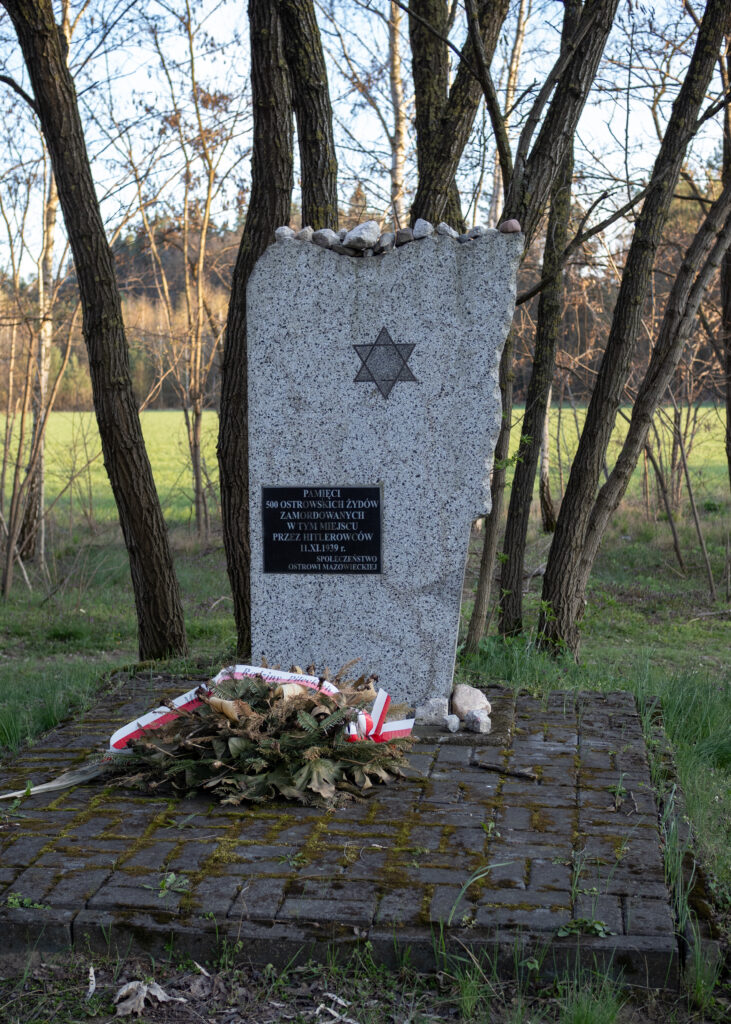
The plaque reads:
The community of Ostrów Mazowiecka..
Notice any missing words? Spoiler: the word is Jewish. Also, notice the martyrdom for the country frame? This frame, I don't think, is a project of antisemitism (or at least not a totalizing one), but it is interesting to mark. I recall also reading that the marker was moved to make way for the road, so it doesn't mark the actual site of the massacre but I'm going to have to dig up that cite when I get home. I'd like to know when it was made (specifically, prior to 1991)? If I find out, I'll update this post. If someone stumbles upon this post and does know, please add it in the comments!
Nonetheless, this oddly framed memorial when contrasted to the memorials in town provides an interesting comparison point for what is prioritized in this place and how stories of the Shoah are told through space.
This is the location where the Tejtel Brewery once stood. The site of the brewery is now an elementary school (Primary School #1) located at ul. Partyzantów 39. Beside the second window on the left, there is a plaque.
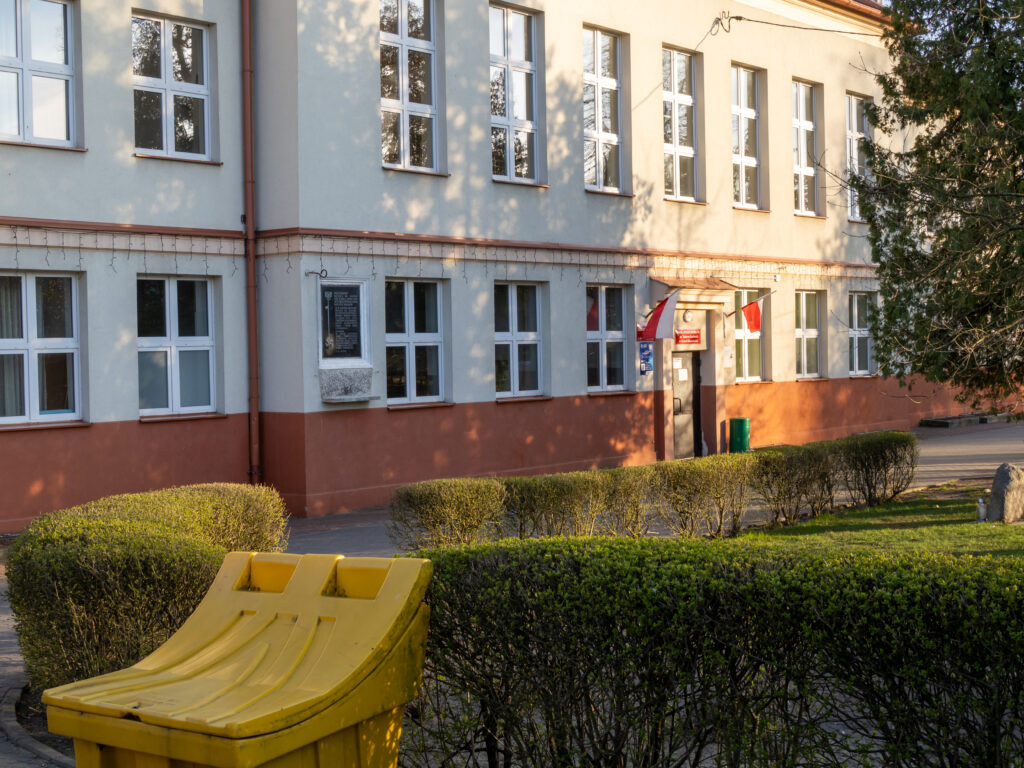
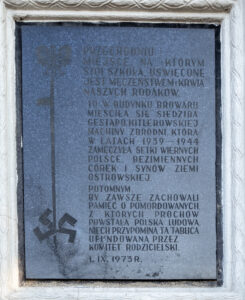
The plaque reads:
To future generations, so that they always remember those who were murdered, upon whose ashes the People’s Republic of Poland was founded — let this plaque serve as a reminder.
Funded by the Parents' Committee. September 1, 1973.
It's really important to understand here that Poland was a communist satellite state of the Soviet Union until 1990. As I understand it, Holocaust commemoration during the earlier parts of this period did not necessarily distinguish the Jewish people as a distinct targeted group on the basis of their identity as Jewish. I've run into a handful of remnant memorials like this one. Here's a quote I think helps the frame:
For the nationalists, whose ideal was an overlap of the political and cultural boundaries, the presence of Jews in Poland’s memory proved that the latter is heterogeneous, which subverted their national project. For the communists, the ethnic and/or religious differentiation of the memory subverted their vision of history, in which ethnicity and religion supposedly had no meaning, having been replaced by economic divisions and gradually levelled by the dominant position of the working class
Just across the small street, there are two Katyn Massacre memorials (22,000 Polish citizens were murdered in mass shootings by the NKVD), including a newer one for the murdered Lieutenant Eugeniusz Olszewski. This particular memorial is a part of a project to plant oak trees for Katyn victims started in 2009 (I wasn’t able to find a good write up explaining how the memorials are selected and placed for Katyn… Save them from Oblivion). There, you will also find now two Called by Name memorials, and two general memorials (including one quintessentially soviet statue).
(click on the first mage to open gallery for descriptions and monument text)
That’s four polish citizens (including two for helping Jewish people) memorialized right next to the brewery that housed Jewish residents before they were shot in a nearby forest, the plaque on which does not mention them at all, and two to the Polish people in general. To get a sense that a great tragedy unfolded here, you need to drive about 3 km away and walk to a forgotten memorial on the side of a highway that has no exit to reach it directly. Interesting also to note that Olszewski seems to be from Krery? I got curious and fell into a bit of a rabbit hole; I assumed the memorialized individuals would be from the town. In the article linked above, Mikhail notes that the tour guide she hired made no mention of the fact that the brewery was originally owned by a Jewish man named Tejtel or that Jewish people had been murdered after being held at that site. The guide shared only that it has been a Gestapo headquarters.
I'm planning to write a longer post unpacking the deeply weird place we stayed just outside of town (a combo restaurant, bar, museum, and hotel dedicated to the history of Poland). But I will offer you a spoiler picture that sums up the gist:
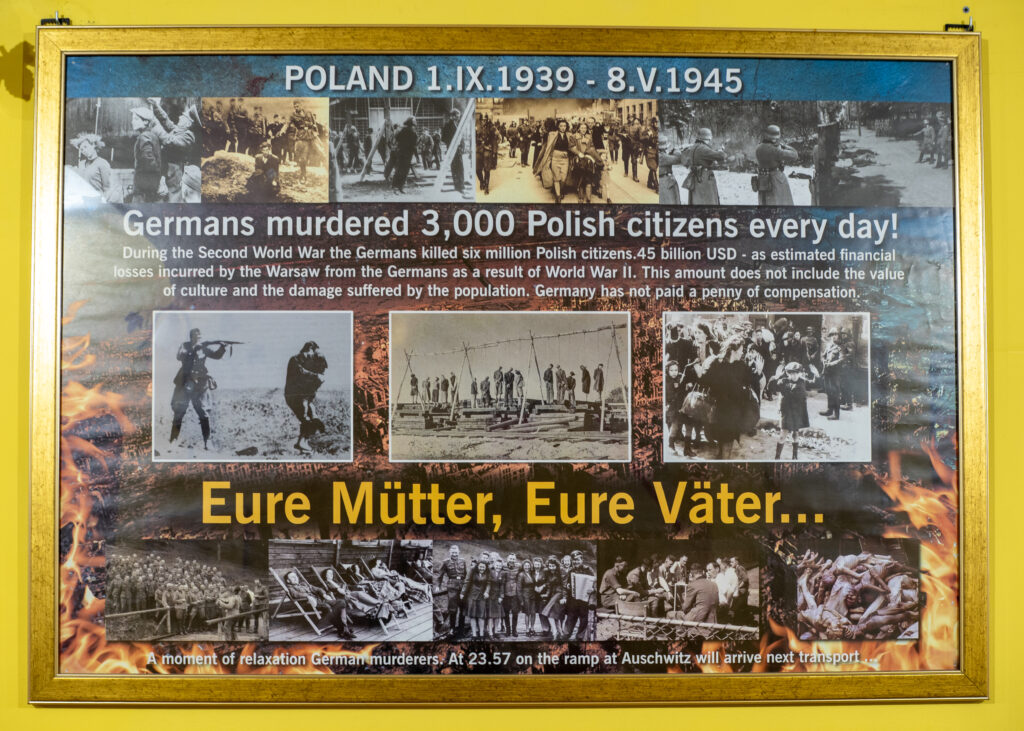
Ostrów Mazowiecka is a *complex* place.
Final Thoughts
Tomorrow, we will visit Treblinka. For more on what residents in close proximity to Treblinka (such as the town we're staying in now) would have known, this article is a grim read. It will take us 14 minutes to drive to a place where 900,000 people were killed.
Snyder again:
Ideologies also tempt those who reject them. Ideology, when stripped by time or partisanship of its political and economic connections, becomes a moralizing form of explanation for mass killing, one that comfortably separates the people who explain from the people who kill. It is convenient to see the perpetrator just as someone who holds the wrong idea and is therefore different for that reason. It is reassuring to ignore the importance of economics and the complications of politics, factors that might in fact be common to historical perpetrators and those who later contemplate their actions. It is far more inviting, at least today in the West, to identify with the victims than to understand the historical setting that they shared with perpetrators and bystanders in the bloodlands. The identification with the victim affirms a radical separation from the perpetrator. The Treblinka guard who starts the engine or the NKVD officer who pulls the trigger is not me, he is the person who kills someone like myself. Yet it is unclear whether this identification with victims brings much knowledge, or whether this kind of alienation from the murderer is an ethical stance. It is not at all obvious that reducing history to morality plays makes anyone moral.
Our contemporary culture of commemoration takes for granted that memory prevents murder. If people died in such large numbers, it is tempting to think, they must have died for something of transcendent value, which can be revealed, developed, and preserved in the right sort of political remembrance… Yet all of these later rationalizations, though they convey important truths about national politics and national psychologies, have little to do with memory as such. The dead are remembered, but the dead do not remember. Someone else had the power, and someone else decided how they died. Later on, someone else still decides why. When meaning is drawn from killing, the risk is that more killing would bring more meaning.
Additional Reading
Dekel, Mikhal. 2023. “Memory Wars in Poland: When My Family’s History Turned Into Political Currency.” Journal of Genocide Research, April, 1–11. https://doi.org/10.1080/14623528.2023.2205187. Online copy here.
Snyder, Timothy. Bloodlands: Europe Between Hitler and Stalin. New York: Basic Books, 2012.
Zalc, Claire, and Tal Bruttmann. Microhistories of the Holocaust. New York: Berghahn, 2019.
Weizman, Yechiel. Unsettled Heritage: Living next to Poland’s Material Jewish Traces after the Holocaust. Cornell University Press, n.d.
Victims of the Nazis, 1933-1944: Poles. US Holocaust Museum https://www.ushmm.org/m/pdfs/2000926-Poles.pdf
Kapralski, Slawomir. “Jews and the Holocaust in Poland’s Memoryscapes: An Inquiry into Transcultural Amnesia.” In The Twentieth Century in European Memory: Transcultural Mediation and Reception, edited by Tea Sindbæk Andersen and Barbara Törnquist-Plewa, 170–97. Brill, 2017. http://www.jstor.org/stable/10.1163/j.ctt1w8h377.13.