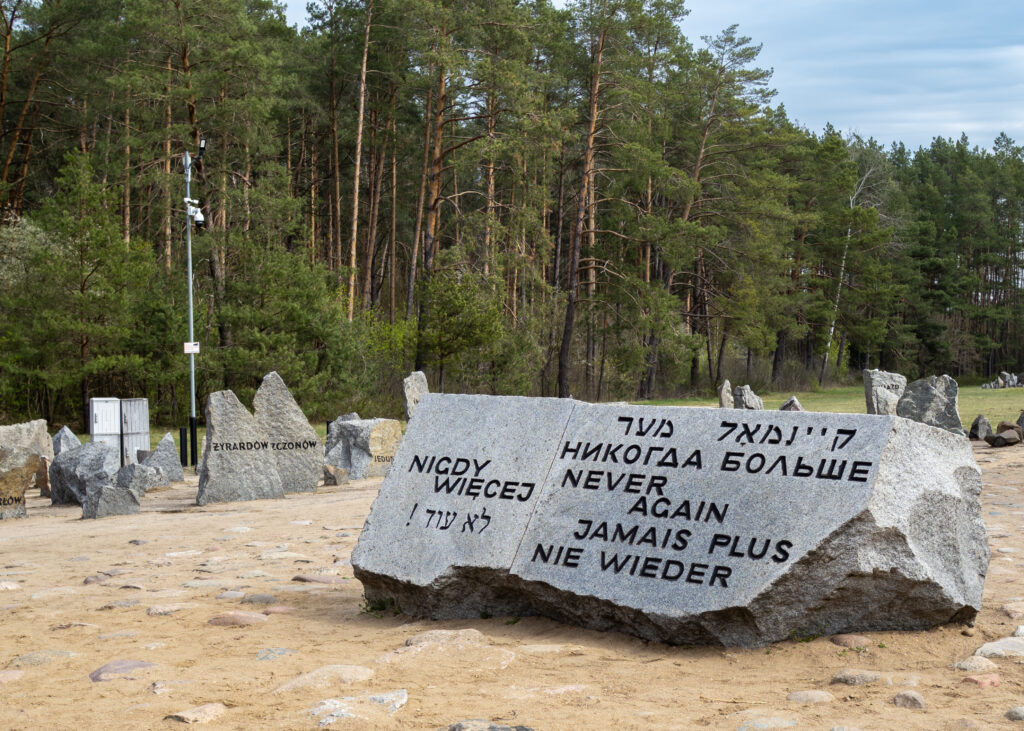
One story that is told about Nazi genocide frames it as an industrialized apex outcome of bureaucratized, cold, efficient murder. The dominant theme centres Auschwitz-Birkenau as emblematic of how death occurred: transport by train, incarceration in camps, tattoos, death in gas chambers. The enemies are clearly identifiable, unambiguously evil, (thus can be framed as outliers in human history), and the history is linear. The truth is messier.
Treblinka is one of many (most, all) spaces that complicates this story, irreparably and in the most stark terms.
I want to drag you into the academic weeds for a second, acknowledging this is cursory and I am a layperson. The history of the academic study of the Holocaust has had several turns, but the space we are in now, broadly speaking, understands the Nazi project of genocide in multiple and competing ways. Peter Longerich in The History of the Holocaust has developed a lens that resonates most deeply for me:
The stupid and the vile work hand in hand with the clever and the efficient. Drunkards and drug addicts kill at the behest of power brokers, logisticians, and a charismatic dictator who should be understood to retain central importance, debates aside. Broken soldiers or civilians-turned-functionaries from the East murder out of self-interest, fear, sheer nihilism, and/or for financial gain. Incompetence and narrative inconsistency are no barrier to effective mass murder on an unfathomable scale. Because, at the heart of this, the Nazi genocide was committed by people.
Ordinary people, not extraordinary monsters made this happen. That is terrifying. That terror is a part of the web that won’t unstick for me.
Treblinka
Treblinka opened in June 1942 and, in just over a year, somewhere upwards of 800,000 people were murdered. Our guide shared something that I hadn't realized before: we only know the names of about 100,000 of these victims (13%). Numbers again, I know. But it is a useful fact to help us understand that the Shoah is not recorded fully in deportation lists of people (like we can see in the Netherlands) but principally in ripping Jewish people from their shtetls and homes, transporting them directly to a death camps purpose built or shooting them in situ or nearby forests, and not bothering to give them a name. Treblinka, Sobibor, and Belzec are still taking testimony to identify and name victims today. I don't know if there is a similar project for the Holocaust by Bullets.
I've quoted Vasily Grossman twice here already, so I should introduce you to him. Vasily Grossman was a writer-turned-war correspondant who followed the Soviet army in their push East. He wrote one of the earliest (and in my opinion most powerful) accounts of a death camp in the news in The Hell of Treblinka (which I am quoting from here).
Hitlerism took from these people their homes and their lives; it wanted to erase their names from the world’s memory. But all of them—the mothers who tried to shield their children with their own bodies, the children who wiped away the tears in their fathers’ eyes, those who fought with knives and flung hand grenades, and the naked young woman who, like a goddess from a Greek myth, fought alone against dozens—all these people, though they are no longer among the living, have preserved forever the very finest name of all, a name that no pack of Hitlers and Himmlers has been able to trample into the ground, the name: Human Being. The epitaph History will write for them is: “Here Lies a Human Being.
Treblinka was the first tour I went on where I saw the camps through the victims. This is strange, I know, but I'm trying for stark honesty in this blog. I have always centred victims in my reading, but that is easier when you can reach for a poem, or a memoir, or a history text at will. All of the spaces I've visited have done an excellent job in this work, but I found myself focusing on abstractions too much. I might have been disoriented, I think. The practice of visiting these places is dislocating and difficult. Auschwitz felt like a bit of a fever dream. You're hustled through that space at such a clip, it is impossible to take time for reflection. Majdanek, which I have yet to write about, was accompanied by weather so intense that I think I was preoccupied by the totalizing horror of the place. As I mentioned, Belzec, maybe by virtue of the fact that we have testimony in full from only one of two (!) survivors, was difficult to grasp and I got lost a bit in numbers. But Treblinka - Treblinka I knew more about going in, including stories about some of the people who were killed there. And we had a gift of a tour guide who paused frequently for us to reflect, to spend time "seeing", and answered endless question after question allowing us to turn a 3 hour tour into 4.5 hours.
I want to bring you into this space of understanding, and share with you a story of someone we lost. I think it embodies the horror of the Shoah: it centres the ways of resistance that are effaced often from the stories of Jewish victims and survivors, and marks out one extraordinary life, of a man who had already changed the world and wasn't given a chance to realize the potential of his life. 1 of more than 800,000, to help us see the scales differently.
Janus Korzcak
That the Jews were led like lambs to the slaughter, passive victims who did not fight back, is a terrible simplification that robs murdered Jewish people of their last moments of agency. Treblinka also put this myth to bed, along with other key sites of rebellion (Sobibor, Warsaw), and myriad other acts of courage we know nothing about.
Here is one small example of a story that we know to serve in place of the many we never will, from Chil Rajchman's memoir. The astonishing bravery of this woman beggars the mind.
All stand as if frozen to the spot. The murderers look around. They become even wilder and the girl laughs in their faces until she leaves.
Robert Rozett defines Jewish resistance as: "planned or spontaneous opposition to the Nazis and their collaborators by individual Jews or group of Jews. In the Nazi system, within which Jews were faced with a process of dehumanization that ultimately culminated in death, any act that opposed that process can be regarded as resistance. In response to this system, Jewish resistance to the Nazis took many forms and worked on many different levels."
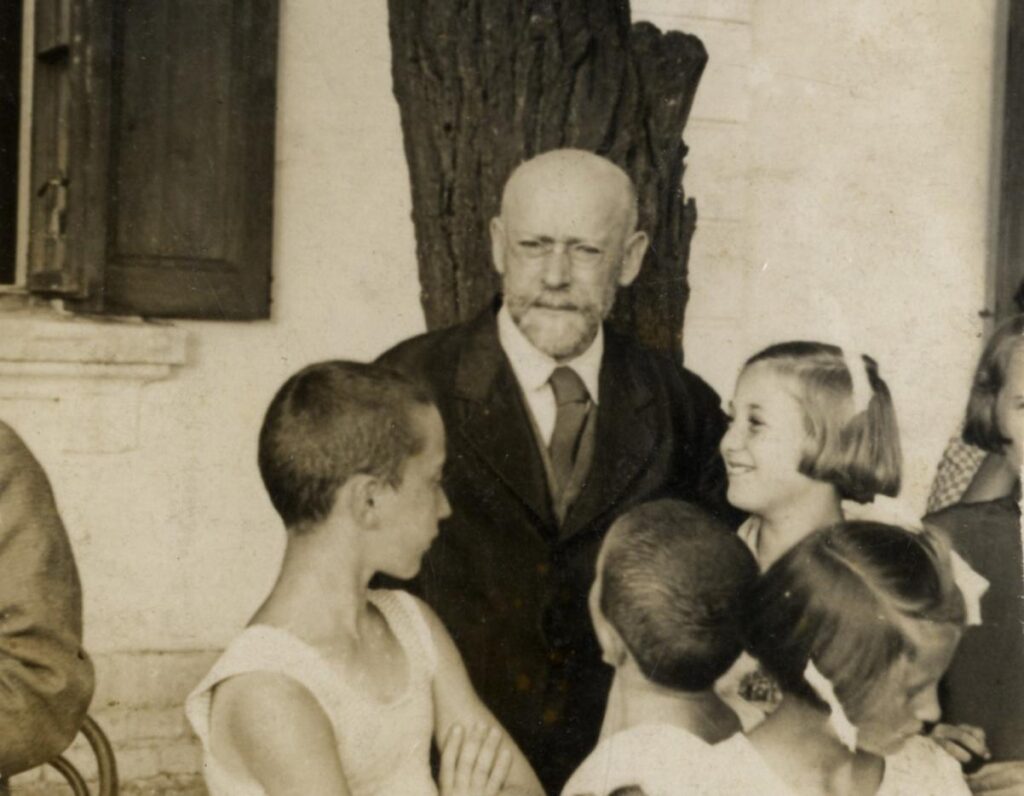
Janusz Korczak was a resister. He refused to allow the Nazis to take his humanity from him, right up until the last.
Janusz was born in 1878 as Henryk Goldszmit was a renowned early advocate for the rights of children, a doctor, and a writer. His children's book King Matt the First is particularly beloved, and still in print. He ran a Jewish orphanage in Warsaw that continued operating into the occupation and period of ghettoization.
From Albert Marrin's A Light in the Darkness:
The Old Doctor understood that children depend on adults, because that is nature’s way. Given this fact, the question was, How should adults use their power? Since every child is worthy of respect, it follows that every child is inherently precious, “a person born to be free.” Thus, Korczak insisted, children do not exist to serve adults’ national, political, economic, or religious aims. Children are people in their own right, not merely adults in the making. Adults must cherish them for themselves, not as living material to be sorted, shaped, molded, counted, cataloged, managed, regulated, regimented, bullied, programmed, trained, directed, commanded, worked, and indoctrinated.
Korczak' career leading up to the occupation was laudatory and remarkable. His final chapter is heartbreaking. He chose twice to stay with his children. When the Jewish-run organizations were made to move to the ghetto, he could have gotten away, and hid. I'm quoting from a book written principally for a younger audience, but I think it's really well done and well sourced:
“And the children?” Korczak asked.
“We’ll try to hide as many as we can in monasteries and private homes.”
“But can you guarantee me that every child will be safe?”
Newerly shook his head. “I’m afraid that’s impossible. We can’t guarantee anything, even our own safety.”
“My friend,” said Korczak, “it is best that I keep the children with me.” There was no other way, for him. The Old Doctor considered himself their father, and like a good father, he could not abandon his loved ones.
And when the ghetto was cleared and the children due to be sent to Treblinka, the legend is that he was offered a chance to not go, and chose to stay with his children. This is apocryphal, but there is plenty of survivor testimony that captured the various stages of his journey to the deportation: walking with his children, accompanying them step-by-step to their deaths.
This recollection from Mary Berg, summarized in Marrin's book is shattering:
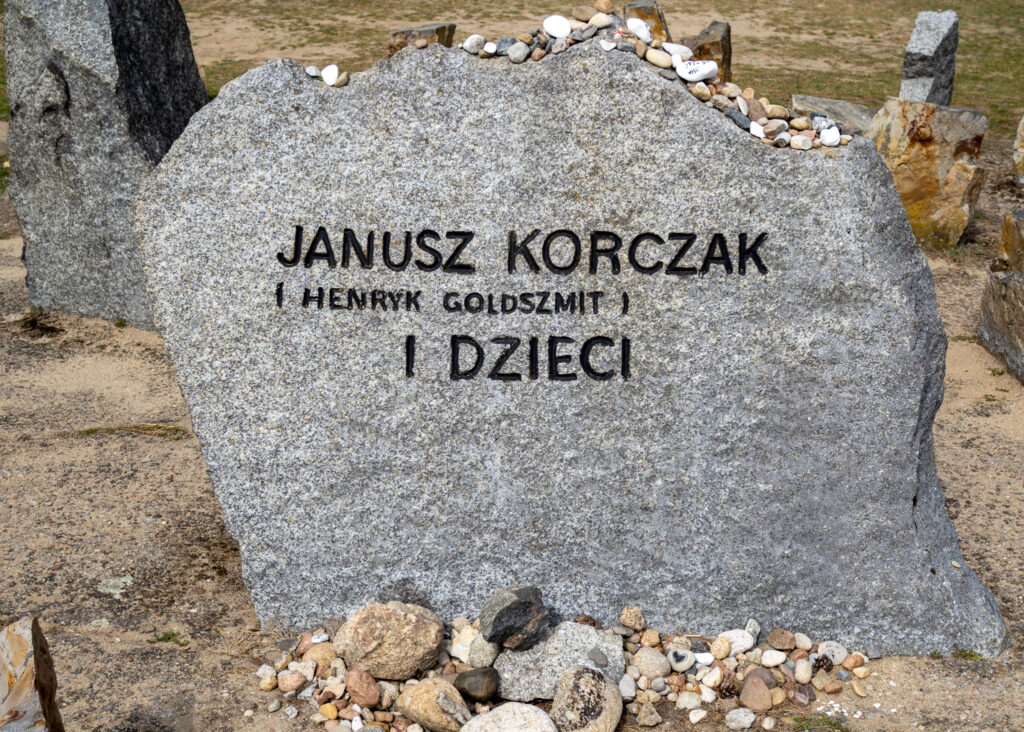
Janusz is the only person to have a named stone in the monument, but if one name has to stand for many, it feels appropriate to me that it is him.
A factual moment-by-moment recounting of what he chose to do in the Warsaw Ghetto leading up to the final deportation to Treblinka would not do justice to Janusz. He was, after all, a story teller and he deserves a hero's ode. I want to end, then, on this poem, and a poem about why it is important to visit Treblinka.
A Page from the Deportation Diary
by Władysław Szlengel

I saw Janusz Korczak today.  He was walking
at the head of his children in line.

They were dressed in clean clothes, as if for an outing
on Shabbat, when the weather's fine.

They wore their holiday jumpers — today
if they're dirtied no one will scold —
as if through the woods the orphanage walked,
five by five, through the hunted crowd.

The pallid and trembling mass that moved
through streets transfixed with dread,
above them the broken windows looked out
empty as eyes of the dead.

And now and then, like a funeral bell
or a lost bird's call, rose a moan —

The lords of the hour in their "rickshaws" rode,
their faces hard as stone.

Footfall and silence: the tramp of feet.

Voices of those who from fear
speak swiftly.  The church on Leszno Street
stood frozen, dumbstruck in prayer.

The children walked quietly.  No one came
to free them.  No one would buy,
for a few bills in a policeman's hand,
the orphans as they passed by.

At the square there was no intervention.

No one plucked Schmerling's* sleeve and whispered,
no one thought of collecting watches
for the Latvian reeking of liquor.

Bareheaded, with fearless eyes,
Janusz Korczak walked on before.
One child held on by his pocket,
And two in his arms he bore.

Someone came running, a paper in hand.
Explained something, gestured: "You've got
a pass from Brandt, you can go home now, sir!"
Janusz Korczak had no use for that.

To the thick-headed bearer of Germany's boon
he did not attempt to explain
what it is to abandon a child in distress —
such thoughts have no place in such brains.

For years he had cared for his children — it seemed
he gave them a new sun each day.

He had vowed to go with them to the end,
he must not turn back halfway.

And little King Matty came to his mind
whose adventure he dreamed long ago —
on the island among the savage tribes
he would have acted just so.

The children got into the boxcars, as if
they were going for a trip on Lag b'Omer**,
and one little boy felt strong and brave —
it was his turn to be "shomer***."

And I thought to myself, as I witnessed that scene
which the eyes of Europe have missed,
that our history knows no more glorious man,
no greater moment than this.

In the midst of a war that is sordid and vile,
an abyss of corruption and shame,
in a nightmare life where men sell their souls
for a few more weeks of the same,

On a front where no medals are handed out
for the combat with things of the night,
Janusz Korczak, the orphans' protector, stood,
the one soldier, strong and upright.
_______________
*Szmerling: Commander of the Jewish Police in Ghetto Warszawa
**Lag Ba'omer - The thirty-three day of the counting of the Omer; a festival
***Hashomer - (Watchman) Jewish self-defense organization founded in 1905. Also name for a member of Hashomer Hatzair (Socialist & Zionist Youth Movement)
Go to Treblinka
Halena Birenbaum

Go to Treblinka
keep your eyes wide open
sharpen your hearing
stop your breathing
and listen to the voices which emerge
from every grain of that  earth –

Go to Treblinka

They are waiting there for you
They long  to the voice of your life
to the sign of your existence,
to the pace of your feet
to human look understanding and remembering
to caress of love over their ashes –

Go to Treblinka

go by your own free will
go by the power of pain over the horror which has happened
from the depth of understanding and the aching heart which has not accepted –
listen to Them there with all your senses!

Go to Treblinka

there the green silence, golden or white
which embrace Them each season of the year
will tell you stories of the stories
about life which became forbidden and impossible –

Go to Treblinka

watch how time has stopped there
listen to the standing time, to the dead thundering silence
and to the human stones weeping there in silence
Go to Treblinka to feel it even for just one second –

Go to Treblinka

grow a flower by a hot tear, by human breath
against one stone – memory of a whole community
on earth which is their flesh and ashes.

They are waiting there in Treblinka for you to come and listen to Them
cry within the silence
and in total mute identification, unifying
bring Them each time the story of life which continues and of reviving love.
Go to Treblinka for generations to generations

Do not leave Them alone -
Additional Reading/Citations
Grossman, Vasily. 2011. The Road: Short Fiction and Articles. Quercus Books.
Arad, Yitzhak. 1987. Belzec, Sobibor, Treblinka: The Operation Reinhard Death Camps. Indiana University Press.
Longerich, Peter. 2010. Holocaust: The Nazi Persecution and Murder of the Jews. Oxford University Press.
Rozett, Robert. “Jewish Resistance.” In The Historiography of the Holocaust, edited by Dan Stone. London: Palgrave Macmillan, 2004.
Rajchman, Chil. The Last Jew of Treblinka. New York: Pegasus Books, 2011.
Korczak, Janusz. 2015. King Matt the First. Farrar, Straus and Giroux.
Marrin, Albert. 2019. A Light in the Darkness: Janusz Korczak, His Orphans, and the Holocaust. Knopf Books for Young Readers
A Page from the Deportation Diary by Władysław Szlengel
Go to Treblinka by Halena Birenbaum